
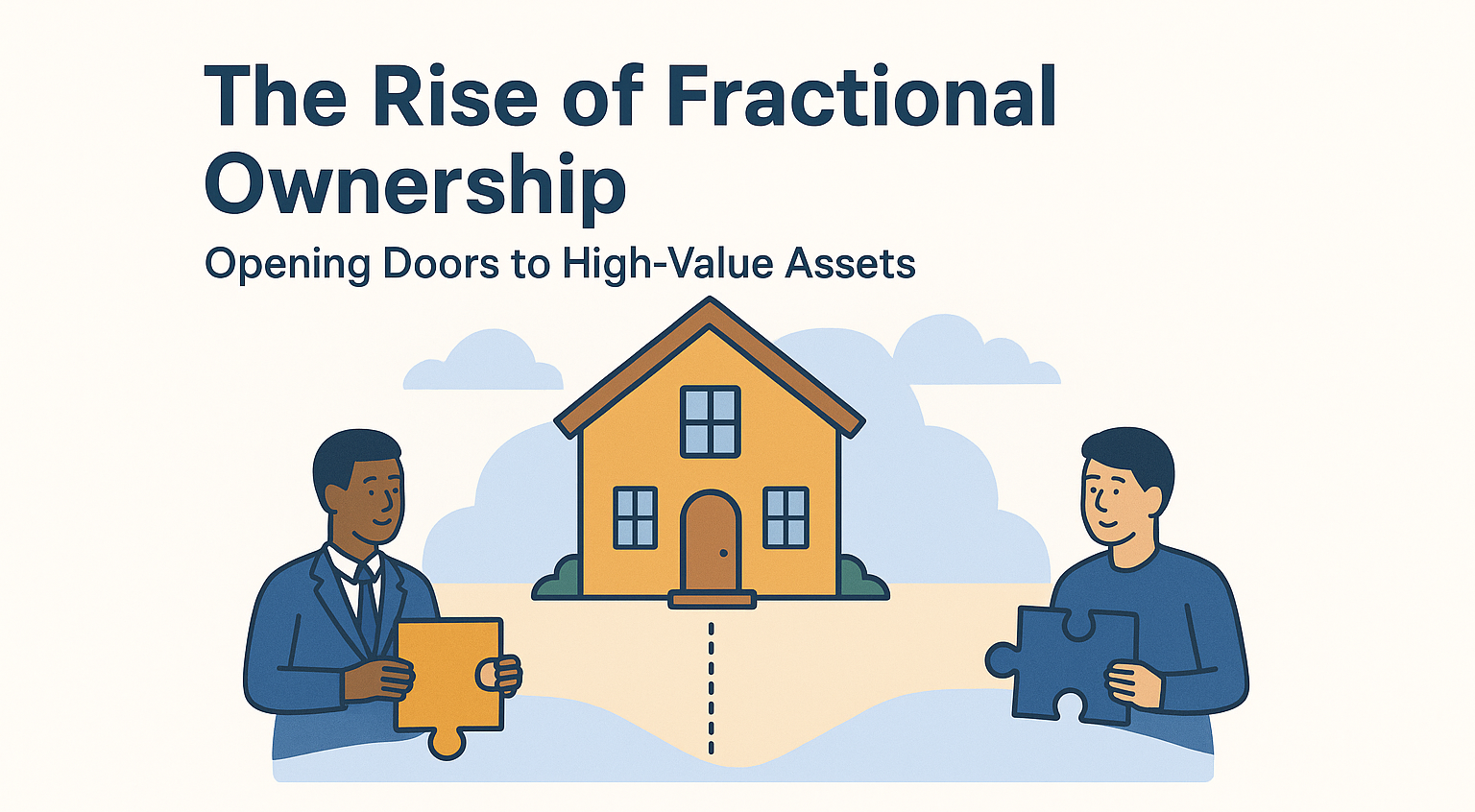
In recent years, fractional ownership has moved from niche to mainstream – especially in real estate, luxury assets, and alternative investments. The core idea is simple yet powerful: instead of owning a whole property or asset, multiple investors each hold a legally recognized share. This model democratizes access, reduces entry capital needs, spreads risk, and allows diversification.
What’s Driving Momentum?
1. Technology & Tokenization
Blockchain, smart contracts, and digital ledgers are making fractional ownership more transparent, programmable, and tradable. Tokenization allows ownership shares to be divided and transferred more fluidly, bridging the gap between real-world assets and digital finance. (Deloitte)
2. Younger Investors, Lower Barriers
Younger generations (Millennials, Gen Z) are less drawn to owning single large assets outright. Estimates suggest that by 2025, over 60% of fractional investors will be under 40. (Lofty) Fractional models allow them to access premium properties (residential, vacation, commercial) with much smaller capital.
3. Regulatory structuring is catching up
In markets like India, regulators are waking up to the need for oversight. SEBI (India’s securities regulator) is pushing for frameworks around fractional ownership in real estate—some platforms are required to hold a minimum stake (e.g. 5–15%) to align incentives and boost confidence. (KPMG Assets) Meanwhile, new instruments like SM REITs (Small & Medium REITs) are being introduced to formalize fractional property investments in regulated structures. (The Economic Times)
4. Yield & Income Appeal
Fractional real estate is being touted as offering net yields of ~7–8% in some markets (after expenses) with lower capital lock-in. (The Economic Times) For many investors, that’s more attractive compared to passive returns from fixed income or residential rentals.
5. Market Growth Projections
Globally, fractional real estate assets under management (AUM) were estimated at ~USD 2.8 billion in 2024, with a projected CAGR of ~16.2% through 2033. (Benzinga) Some forecasts envision the tokenized real estate market (wider than only fractional models) ballooning toward USD 4 trillion by 2035. (Deloitte) In established markets, the fractional ownership segment is still relatively small (e.g. USD ~500 million in AUM today) but with high potential growth. (JLL)
Market Insights & Challenges
While the tailwinds are strong, fractional ownership is still a frontier with real challenges. Here are some of the critical issues and insights to watch:
| Area | Insight / Risk | What to Watch / Mitigate |
| Liquidity & Tradability | Many tokenized assets show low trading activity, long holding periods, and poor secondary market liquidity. (arXiv) | Platforms must build deeper secondary markets or hybrid liquidity mechanisms (e.g. buyback guarantees, market makers). |
| Regulatory Uncertainty | Some platforms operate in legal gray zones. In India, one major platform, Strata, recently surrendered its SEBI registration amid legal disputes. (The Economic Times) | Investors should check regulatory compliance, platform track record, and whether the asset structure is aligned with securities laws. |
| Platform & Governance Risk | Shared ownership means decisions on maintenance, usage, repairs, and exits need robust governance. Disputes can arise among co-owners. | Legal frameworks (LLCs, trusts, agreements) must be airtight. Platforms need clear rules, arbitration mechanisms, and transparency. |
| Valuation & Transparency | Real estate valuations can lag; fair pricing of fractional shares, especially in distressed conditions, is tricky. | Frequent third-party valuations, transparent reporting, and disclosure standards are important. |
| Capital Lock-in & Exit Pathways | Some models require minimum holding periods or restrict early exits. | Platforms should design exit liquidity paths (secondary markets, redemption windows) from day one. |
| Scaling & Asset Quality | Getting high-quality assets (prime real estate, premium location) is more challenging than lower grade ones. | Platforms must maintain rigorous selection criteria, due diligence, and partnership networks. |
Recent Developments Worth Noting
- In India, fractional real estate is being marketed with 7–8% net yields, lowering the barrier for retail investors. (The Economic Times)
- SEBI and Indian regulators are actively structuring SM REITs as a regulated vehicle to host fractional investments. (The Economic Times)
- Major misstep: Strata, a prominent platform, surrendered its SEBI registration amid legal complications – serving as a caution for due diligence. (The Economic Times)
- Globally, fractional co-buying of vacation homes is gaining traction. In the Carolinas (USA), co-ownership models are being used to enable buyers to “own a slice” of luxury vacation property rather than full ownership. (Axios)
- On the academic/technical side, new research is probing liquidity models for fractional and tokenized real assets, and proposing hybrid architectures to improve tradability. (arXiv)
How Should Investors & Builders Position Themselves?
- Start with small allocation, but validate platforms deeply
Allocate only a portion of your investments into fractional models initially. Focus on platforms with transparent structures, credible management, and proven exit mechanisms. - Check liquidity strategy early
Ask: how can I sell my share? What is the expected time frame? Are there secondary markets or exit windows? - Diversify across assets & geographies
Don’t tie up all your capital in one property or location. Fractional models make it easier to spread across assets, which is a core strength. - Keep an eye on technology and interoperability
Platforms that can interoperate (token standards, marketplace integration) will likely be more resilient and liquid. - Watch regulatory signals and court decisions
Especially in markets like India, legal precedents, regulatory rulings, or platform failures will significantly alter sentiment and structure.

Hi, I’m Saurabh – Marketing Manager at RealX and the person behind the stories, ideas, and insights you read on Wassup. My job allows me to dive deep into consumer behaviour, brand-building, and the fast-changing world of digital innovation, and Wassup is where I share those learnings in a simple, approachable way.
Thanks for stopping by – hope Wassup adds a little clarity, curiosity, and value to your day.
I do not even know how I ended up right here, however I thought this post used to be great. I do not know who you’re but certainly you’re going to a famous blogger in case you are not already 😉 Cheers!