
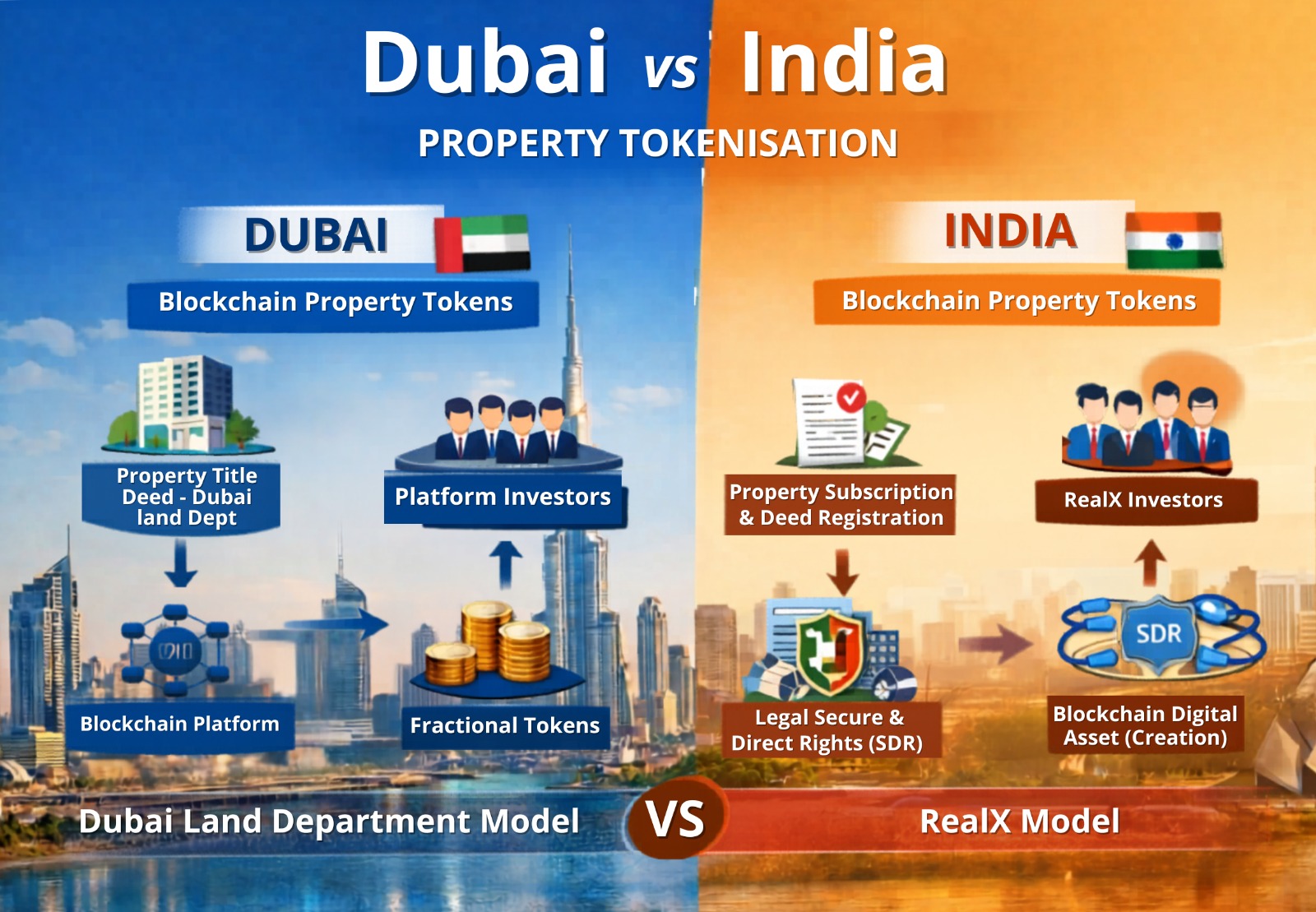
Dubai announced $16 billion of tokenized real estate by 2033.
Big number & Impressive ambition – classic characteristic of Dubai we all like. I’d also add that they’re genuinely worth paying attention to.
Having said that, we at RealX have been staying put and built an Indian Tokenisation model – legal, secure and digital.
As the picture may suggest, both models are eerily similar too.
There’s fundamental difference between what Dubai is building and what RealX has built. And that difference matters for how you think about India’s position in this race.
Dubai: Regulation-first. VARA, DIFC, RERA Dubai – new regulatory frameworks written specifically to enable tokenization. New law for new technology – Top-down, Government-led, Well-funded.
RealX: Law-first. No sandbox. No special dispensation. No new regulation required.
The Transfer of Property Act, Registration Act, Contract Act, IT Act. FEMA. SEBI guidance and rulings. All existing, All applicable & All already used.
I am not saying one is better than the other. I am saying they are fundamentally similar but slightly different bets.
Regulation written for a specific technology is always at risk — the next iteration of the technology may require the regulation to be rewritten. Law built on property rights and trust structures has stood for over a century – It doesn’t need to be rewritten when the token standard changes.
The 2nd difference is who it’s for.
Dubai’s tokenization is largely built for global HNIs investing in high-end property. The audience is international. The product is elegant. The beneficiary is global capital.
RealX is built for Indian investors investing in Indian property. The minimum threshold is low – and INR low, not USD low. The beneficiary is the Indian professional, the salaried employee, the first-time investor who never got access to the Pune commercial property or the Ayodhya development plot because the ticket size was ₹1 crore+.
Two very different ideas of who the market is for.
The third difference is what “tokenization” actually means.
In many Dubai transactions, tokenization is a representation layer on top of conventional ownership – the token points to a certificate that points to a title. The chain of rights still runs through traditional structures.
In RealX construct, the token IS the right. The Secure Digital Right encoded in each FRAX token is itself the beneficial ownership instrument, governed by the legal framework & enforceable in Indian courts. The blockchain isn’t decorative. It’s load-bearing.
Dubai is building a global tokenized asset marketplace. They will likely succeed at that – and it’s the right product for their market.
RealX is building participative wealth infrastructure for India – different ambition but much larger potential beneficiary base and a more durable structure.
Both needed. Its just been little harder for us – but we chose it and now we’re there.
Manish is the Co-founder and CEO of RealX