
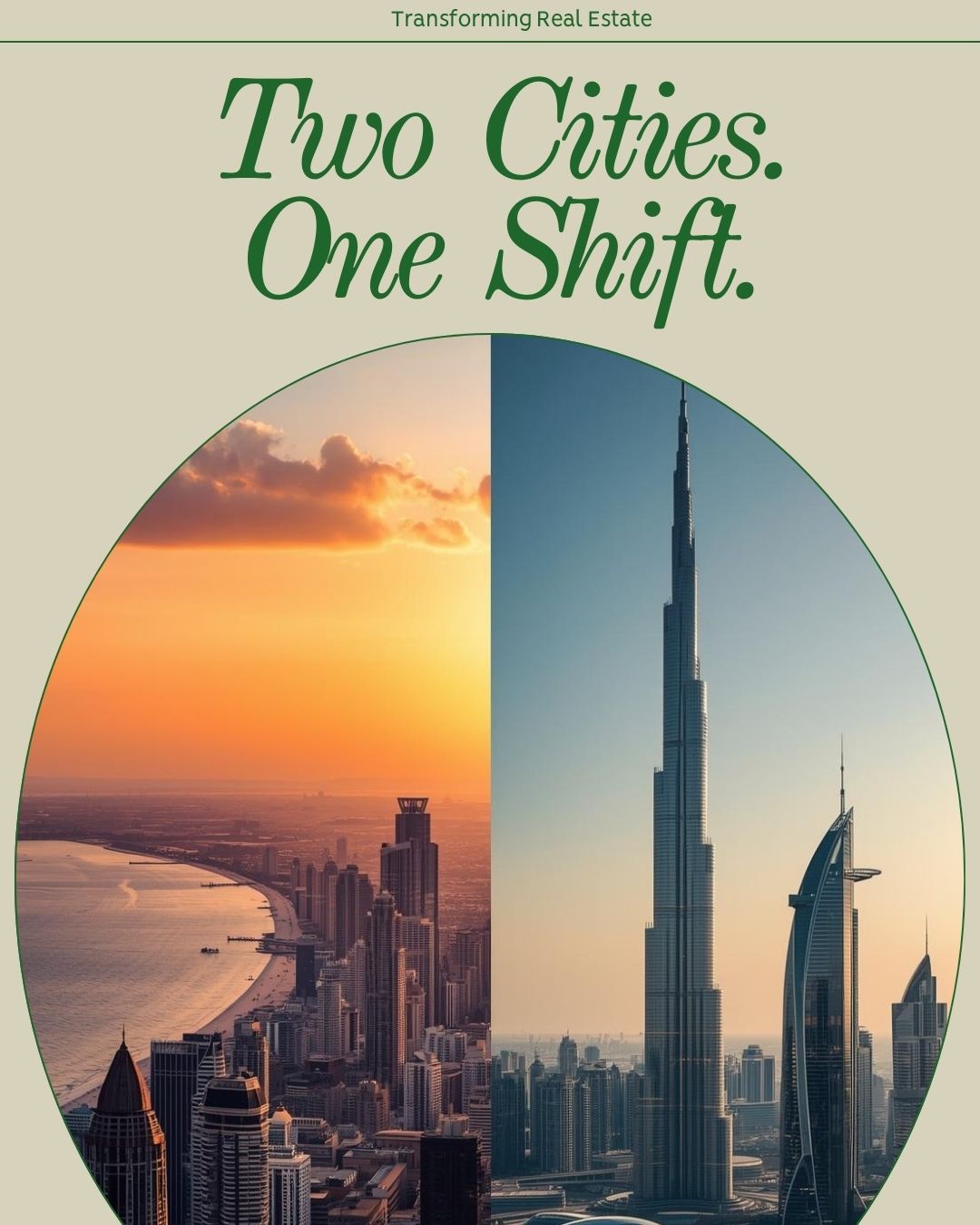
Fast-paced skylines, coastal financial powerhouses, rapid urban expansion, global capital flows, and a massive, diverse investor base.
Wondering which cities we’re talking about?
Well, you guessed it right – Mumbai and Dubai.
Two cities. Two global real estate magnets.
And increasingly, two case studies in how property ownership is evolving in the age of tokenisation.
In Mumbai, property prices have consistently outpaced income growth, turning prime real estate into a long-term aspiration rather than an accessible investment. In Dubai, world-class infrastructure and investor-friendly policies have attracted global capital, but premium assets still remain concentrated among high-net-worth investors and institutions.
Despite their differences, both cities share one structural reality:
high-value real estate markets with high entry barriers.
Large ticket sizes, complex legal processes, geographic limitations, and long holding periods have traditionally made direct ownership difficult for the average investor. For decades, access to institutional-grade property in these cities was limited to funds, developers, and ultra-wealthy buyers.
This is where tokenised property begins to shift the conversation.
Instead of demanding full ownership of a physical asset, tokenisation enables fractional participation in real estate – allowing investors to own a share of a premium property rather than the entire asset. In markets like Mumbai and Dubai, where a single prime asset can require substantial capital, this model significantly lowers the entry barrier while maintaining exposure to high-value locations.
But accessibility is only one part of the story.
Traditional real estate funds and REIT-like structures have long provided indirect exposure to property markets. They offer professional management and regulatory familiarity, but they often come with lock-in periods, limited transparency, and minimal investor control over underlying assets. Investors essentially gain exposure to a portfolio, not ownership visibility.
Tokenised real estate, on the other hand, introduces a more transparent and programmable ownership structure. Digital ownership records, automated income distribution and potential secondary transferability create a fundamentally different investor experience, one that aligns more closely with modern, digitally native capital markets.
Dubai, in particular, is positioning itself as a forward-looking hub for digital asset infrastructure, supported by initiatives from institutions such as the Dubai Land Department, which has actively explored blockchain-based property frameworks. Mumbai, while more traditionally structured, represents one of the largest untapped markets where fractional access could unlock participation from a rapidly growing middle-affluent investor class.
However, tokenisation does not magically make real estate cheaper.
A luxury asset in South Mumbai or Downtown Dubai remains a luxury asset.
What it changes is who gets to participate.
Instead of being excluded due to capital constraints, investors can gain exposure to premium real estate markets with smaller allocations, diversified ownership, and potentially greater liquidity compared to conventional property investments. This becomes especially relevant in 2026, where investors are increasingly prioritising flexibility, transparency and global diversification over purely static ownership.
That said, accessibility through tokenisation comes with its own considerations – regulatory compliance, asset governance, secondary market depth and custodial infrastructure still play a critical role in determining whether tokenised property can scale sustainably.
So the real question is no longer:
“Can investors afford property in cities like Mumbai and Dubai?”
But rather:
“Can technology redefine how ownership in these cities is structured and accessed?”
The answer is Yes!
Technology and governance together can and will change the ownership structure in the real estate market.

With a strong interest in markets and emerging financial infrastructure, I’m driven by how thoughtful design and disciplined decision-making can create lasting value. My work centres on creating robust financial frameworks that balance innovation with stability and long-term impact. I believe the best outcomes come from patience, clarity and long-term thinking.