
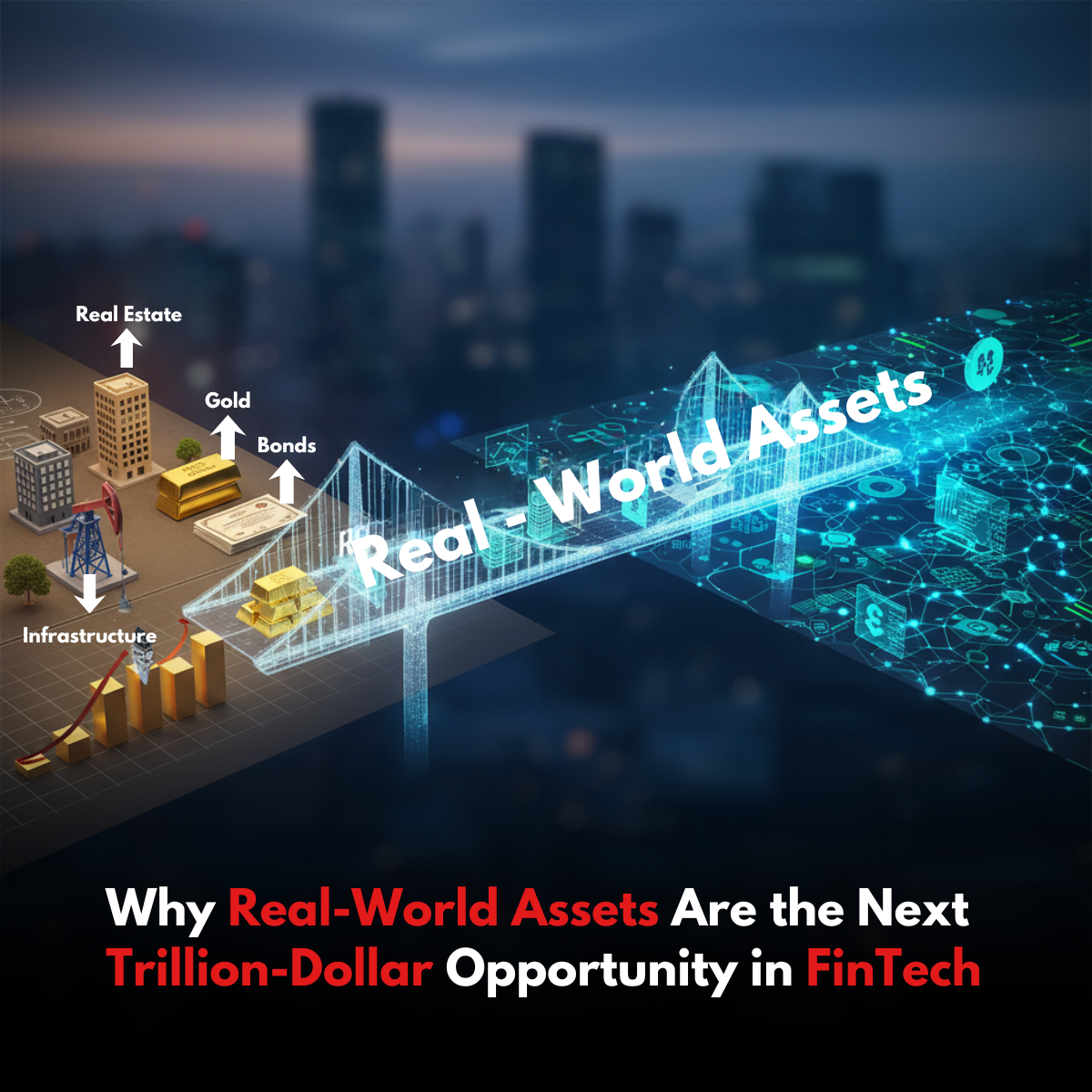
The financial industry is undergoing one of its most transformative shifts since the inception of online banking. Traditional investments – including real estate, gold, and infrastructure – are rapidly moving onto blockchain platforms through a process known as Real-World Asset (RWA) tokenization. This fintech revolution is not hype or a distant vision; it is actively reshaping global finance right now, backed by governments and institutions worldwide. Analysts forecast the tokenized asset market to exceed $2 trillion by 2028, propelled by technological infrastructure, regulatory clarity, and growing institutional adoption.
Discover why Real-World Assets tokenization is reshaping digital finance and how investors, businesses, and innovators can capitalize on this trillion-dollar opportunity.
What Are Real-World Assets (RWA) Tokenization?
Real-World Assets refer to tangible and traditional financial instruments existing offline – such as:
- Real estate properties
- Government and corporate bonds
- Private credit and debt instruments
- Commodities like gold, oil, and metals
- Energy and infrastructure projects
- Luxury goods and collectibles
Through blockchain technology, these assets are digitized as tokens enabling fractional ownership. This process transforms traditional high-barrier investments into globally accessible, liquid financial products with near-instant settlement backed by blockchain-verified ownership.
Traditional vs Tokenized Asset Ownership
| Feature | Traditional Assets | Tokenized Assets |
| Entry Barriers | High | Fractional and accessible |
| Settlement Speed | Days to weeks | Near-instant |
| Market Access | Restricted by geography & regulation | Global borderless access |
| Liquidity | Often illiquid | Higher liquidity through trading |
| Ownership Records | Paper documents | Blockchain-based proof of ownership |
Tokenization pushes asset investment into the digital age, just as e-commerce revolutionized retail.
Why RWAs Are the Next Trillion-Dollar FinTech Opportunity
FinTech has evolved through major stages:
| Era | Innovation | Examples |
| 1990s–2000s | Internet Banking | Online payments, net banking |
| 2010s–2020s | Crypto & Digital Currency | Bitcoin, stablecoins, DeFi |
| 2024 onward | Asset Tokenization (RWA) | Tokenized real estate, bonds, credit |
Currently, the on-chain RWA market surpasses $35 billion and is growing rapidly, analogous to the internet’s early days in the late 1990s.
Key Drivers Accelerating Tokenized RWAs:
- Institutional adoption and government pilot programs
- High interest rates boosting demand for tokenized debt
- Growing appetite for fractional alternative investments
- Standardized blockchain infrastructure and protocols
- Emerging global regulatory clarity
With robust technology and legal frameworks now available, RWAs offer regulated, scalable ownership representation of tangible assets.
How Real-World Asset Tokenization Works
The tokenization process includes:
- Asset Selection: Choose an asset like a commercial property or government bond.
- Legal & Financial Structuring: Place the asset within a regulated structure (trust or entity).
- Custody & Verification: Asset custody with audits to ensure legitimacy.
- Token Issuance: Create digital tokens on blockchain representing ownership.
- Investor Purchase: Investors acquire fractional ownership via tokens.
- Trading & Settlement: Tokens trade peer-to-peer or on digital platforms.
- Yield & Returns: Rental incomes, dividends, or interest are distributed on-chain.
Essential Technologies
- Blockchain platforms (Ethereum, Stellar, Avalanche)
- Smart contracts for automation
- Digital custodians ensuring asset security
- KYC/AML compliance systems
- Auditing and trust frameworks for transparency
This structured approach results in transparent, programmable, and fully regulated digital asset ownership.
Global Adoption & Market Momentum
Governments worldwide are actively supporting RWA tokenization:
- Malaysia’s national tokenization framework drives local adoption.
- Singapore partners with licensed platforms pioneering tokenized asset markets.
- Hong Kong and China regulate and pilot RWA business models.
- The U.S. and Europe test tokenized government debt and treasury products.
This phase is a financial infrastructure upgrade, separate from speculative crypto trends.
Institutional Interest and Corporate Strategies
- Over 20 listed corporations have announced RWA tokenization strategies.
- Banks, asset managers, and fund houses are developing dedicated tokenization divisions.
- Use cases targeted include tokenized government bonds, private credit lending, and on-chain treasury products.
Technology Partnerships
- Stellar and Chainlink integrate decentralized finance with real assets.
- Banking-grade custodians enter the tokenization space.
- Token standards mature, enabling cross-chain interoperability, connecting TradFi and Web3 ecosystems.
Top Real-World Asset Classes Being Tokenized Right Now
- Real Estate: Fractional ownership in residential and commercial properties, lowering entry costs and enabling borderless investments.
- Government & Corporate Bonds: Treasury bill tokenization gains momentum amid high yields.
- Gold & Commodities: Digital gold adoption surges, especially in markets like India and UAE.
- Private Credit & Invoice Financing: Unlocking liquidity in the trillion-dollar private credit market.
- Infrastructure & Renewable Energy: Solar farms, green energy credits, and infrastructure debt tokenizations gain prominence, notably in emerging economies including India.
Benefits of Tokenizing Real-World Assets
| Benefit | Impact |
| Fractional Ownership | Democratizes access to premium assets |
| Global Access | Invest from anywhere, without borders |
| Instant Settlement | Eliminates paperwork delays, expedites trades |
| Transparency | Blockchain-verified, immutable ownership |
| Liquidity | Enables trading in traditionally illiquid assets |
| Programmability | Automated payouts and compliance via smart contracts |
| Lower Costs | Reduces intermediaries, improving efficiency |
For investors, this means real assets combine with crypto-like liquidity. Asset owners can unlock capital faster and more efficiently.
Risks & Challenges to Consider
- Liquidity is still developing in many markets.
- Regulatory environments vary widely across jurisdictions.
- Custody and linking digital tokens to physical assets require trust.
- Smart contract vulnerabilities exist on-chain.
- Valuation and audit standards are advancing but not yet fully mature.
Responsible adoption and robust compliance frameworks remain crucial.
The Future Outlook for RWA Tokenization
Expect ongoing developments:
- Tokenized government securities will become mainstream.
- Banks will offer tokenized funds to retail and institutional clients.
- Real estate investing will become fully digitalized.
- Cross-jurisdictional standardization will emerge.
- Global RWA exchanges will develop.
- India and UAE will grow as tokenization hubs.
- Retail wealth platforms will integrate RWAs into their offerings.
Just as demat shares replaced physical certificates, tokenization is poised to transform all asset ownership digitally within the next 5–10 years.
Conclusion
Real-World Asset tokenization is not a passing fintech trend; it is the foundational evolution of global finance. By merging the stability and tangible value of real assets with blockchain’s efficiency, transparency, and programmability, a new generation of wealth-building opportunities opens up. Early adopters – from investors to institutions – will gain a significant advantage in this on-chain revolution.
The financial world is going digital, and Real-World Assets are leading this transformation.
References:
- https://procreator.design/blog/best-fintech-ux-practices-for-mobile-apps/
- https://mintposition.co/fintech-seo/
- https://nogood.io/2025/03/04/fintech-seo/
- https://startupvoyager.com/fintech-seo/
- https://seekmarketingpartners.com/digital-marketing-blog/seo-guide-for-fintech-2025/
- https://www.omnius.so/blog/fintech-seo-trends
- https://www.webstacks.com/blog/content-strategy-for-fintech
- https://www.madx.digital/learn/seo-for-fintech
- https://www.omnius.so/blog/fintech-seo-strategies
- https://www.mintcopywritingstudios.com/blog/fintech-seo-agency
Hi, I’m Saurabh – Marketing Manager at RealX and the person behind the stories, ideas, and insights you read on Wassup. My job allows me to dive deep into consumer behaviour, brand-building, and the fast-changing world of digital innovation, and Wassup is where I share those learnings in a simple, approachable way.
Thanks for stopping by – hope Wassup adds a little clarity, curiosity, and value to your day.
This blog is definitely rather handy since I’m at the moment creating an internet floral website – although I am only starting out therefore it’s really fairly small, nothing like this site. Can link to a few of the posts here as they are quite. Thanks much. Zoey Olsen