
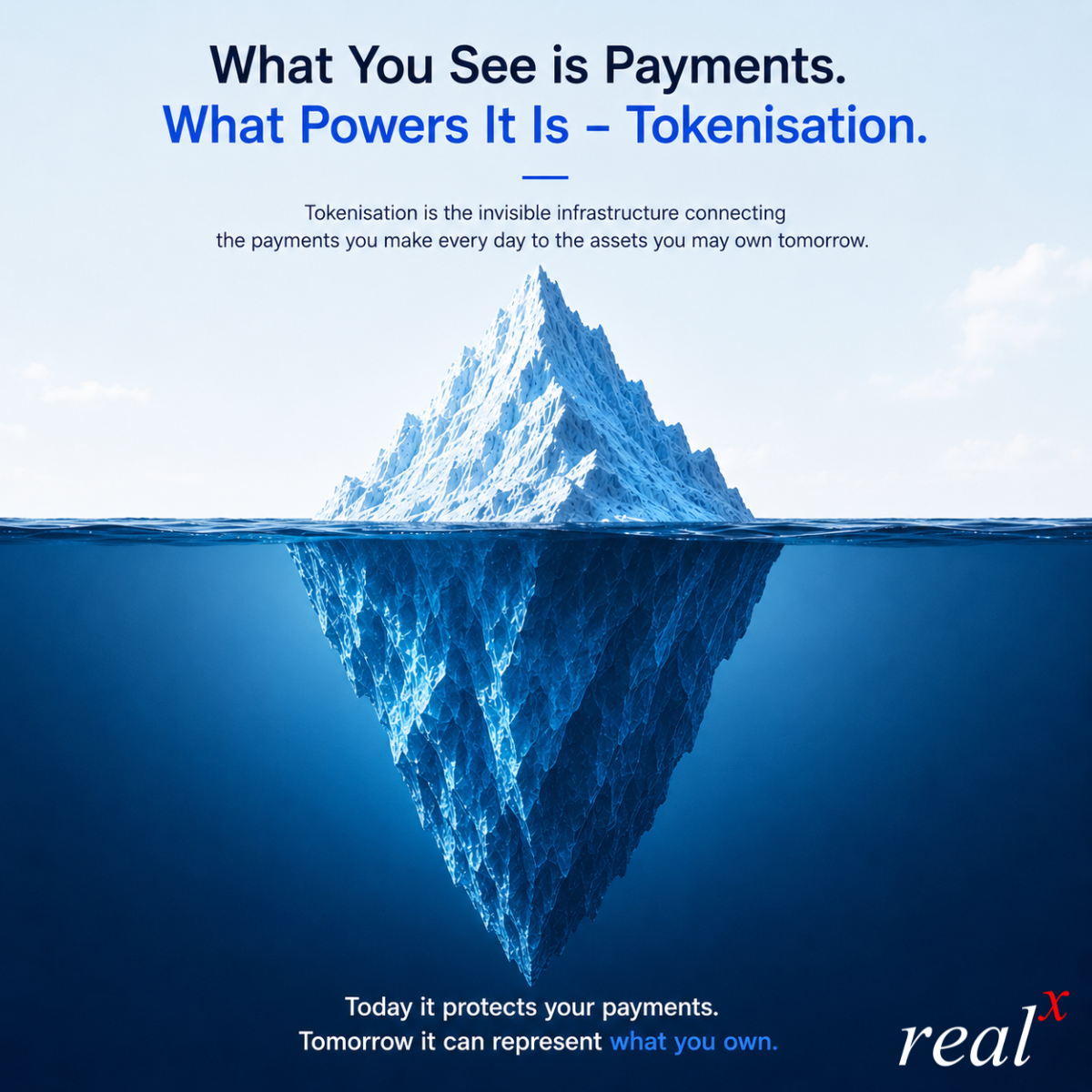
When people hear the word tokenisation, they often think of blockchain, cryptocurrencies or digital assets. It sounds futuristic, complex and far removed from everyday life.
But the reality is quite different.
Millions of Indians already use tokenisation every single day-most just don’t realize it.
Apple’s recent decision to restore card payments in India is a timely reminder. After several years of relying on alternative payment methods, Apple has once again enabled eligible Visa and Mastercard payments by complying with the Reserve Bank of India’s card tokenisation framework.
While this may appear to be just another payments update, it signals something much larger: tokenisation has quietly become part of India’s financial infrastructure.
The First Wave: Securing Payments
India’s card tokenisation initiative was introduced to improve the security of digital payments.
Instead of merchants storing a customer’s actual 16-digit card number, a unique digital token is generated and used for transactions. Even if that token is compromised, the original card details remain protected.
For consumers, the experience is almost invisible. Payments remain seamless. Transactions become more secure. Trust in digital commerce grows.
Today, billions of online transactions depend on this technology, yet very few users think about the tokenisation happening behind the scenes.
That is often the hallmark of successful technology—it becomes so reliable that people stop noticing it.
When Technology Becomes Infrastructure
Apple’s return to card payments illustrates more than regulatory compliance.
It demonstrates that global technology companies are willing to redesign their systems to align with India’s digital payment standards rather than work around them.
Banks, payment networks, regulators and technology providers have collectively built an ecosystem where tokenisation is no longer an experiment. It is an accepted layer of financial infrastructure.
Consumers don’t ask whether their payment is tokenised.
They simply expect it to be secure.
The Next Evolution of Tokenisation
Payment tokenisation protects information.
The next evolution of tokenisation represents ownership.
Instead of a token standing in for a payment credential, it can represent ownership in a real-world asset—such as commercial real estate, government securities, private credit, infrastructure, renewable energy projects or other financial assets.
This is the foundation of Real World Asset (RWA) tokenisation.
While payment tokenisation and asset tokenisation solve different problems, they are built on a similar principle: replacing traditional representations with secure digital tokens that are easier, safer and more efficient to manage.
One secures transactions.
The other has the potential to transform how ownership is issued, transferred and accessed.
A Familiar Path to a New Financial Future
Every major technological shift follows a similar pattern.
It begins by solving a practical problem.
It gains regulatory support.
Institutions adopt it.
Consumers begin using it without thinking about the underlying technology.
Payment tokenisation has already completed much of this journey in India.
Asset tokenisation is now beginning its own.
Looking Ahead
India has already embraced tokenisation as a way to secure digital payments.
The next chapter is not about protecting value—it is about representing value itself.
As regulatory frameworks continue to evolve and financial institutions build the necessary infrastructure, tokenisation is expanding beyond payments into the world of investments and ownership.
The question is no longer whether tokenisation will become mainstream.
The question is which asset classes will be transformed next.

With a strong interest in markets and emerging financial infrastructure, I’m driven by how thoughtful design and disciplined decision-making can create lasting value. My work centres on creating robust financial frameworks that balance innovation with stability and long-term impact. I believe the best outcomes come from patience, clarity and long-term thinking.
Connect: radhika@realx.in