
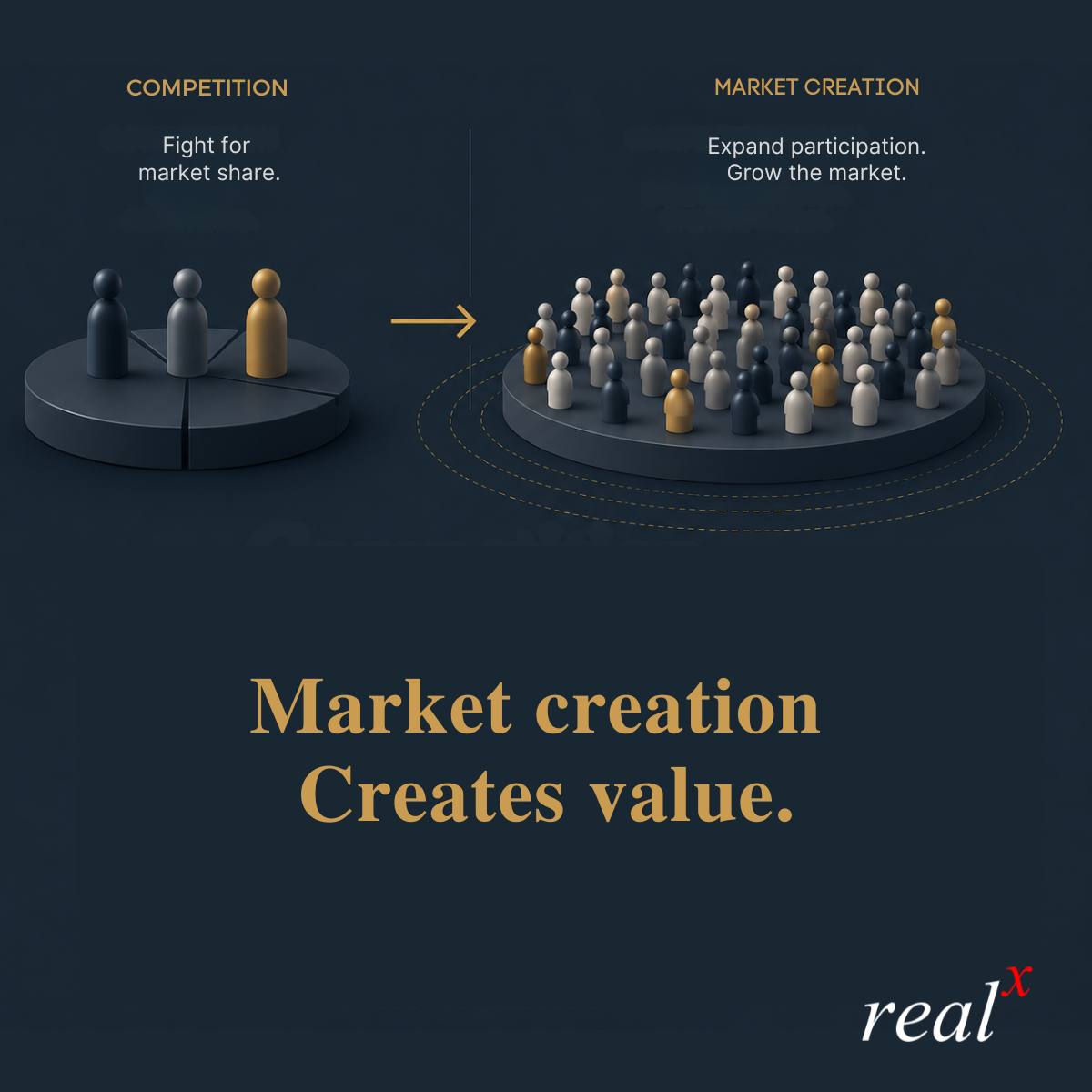
Most businesses are taught to compete.
But the biggest economic shifts in history rarely happen because someone won an existing market. They happen because someone created an entirely new one.
Competition Has Limits
When companies compete inside an existing market, they’re fighting over the same customers.
Think about airlines. Think about telecom operators. Think about food delivery apps. In each of these industries, one company’s gain is usually another’s loss. Market share moves from one player to another, but the size of the pie changes slowly, if at all.
This is the quiet limitation of competition: it redistributes value. It rarely creates it.
Market Creation Changes the Equation
The businesses that reshape entire industries didn’t simply outperform their competitors. They expanded who could participate in the first place.
- Airbnb didn’t steal hotel guests – it created a market where millions of ordinary homeowners became accommodation providers.
- Uber didn’t just compete with taxis – it made on-demand transportation accessible to millions of people who previously wouldn’t have hailed a cab as often, or at all.
- Shopify didn’t just take share from existing e-commerce platforms – it enabled millions of individuals and small businesses to become online merchants for the first time.
- UPI didn’t just replace cash – it dramatically expanded digital payments by making transactions simple, fast and nearly universal across India.
| Platform | Then | Now |
|---|---|---|
| Airbnb | Traditional hotels dominated accommodation supply | 8M+ active listings |
| Shopify | Few independent online sellers | Millions of active merchants |
| UPI | Hundreds of millions of digital payment transactions annually | 17+ billion transactions per month (2024–25 range) |
Look closely at each of these and the common thread isn’t technology. It’s participation. New participants create new markets and new markets create value that didn’t exist before.
The Pattern
Every major market expansion tends to follow a similar path:
Barrier goes down → Participation goes up → Transactions increase → Market size grows
Markets grow not because existing participants trade harder or more often, but because more people gain the ability to participate at all. Lower the barrier to entry, and everything downstream follows.
Where Real Estate Fits
Real estate has always been one of the largest asset classes in the world. And yet participation in it has remained remarkably limited.
High capital requirements. Large ticket sizes. Limited liquidity. Restricted access to the best-performing assets.
These aren’t constraints on the underlying assets themselves – the buildings, the land, the cash flows they generate. They’re constraints on the market around those assets: who is allowed in and on what terms.
Tokenization Is Market Infrastructure
Most conversations about tokenized real estate stop at “fractional ownership” — the idea that you can now own a slice of a property instead of the whole thing. That’s true, but it undersells what’s actually happening.
Go one level deeper, and the more interesting story emerges: tokenization doesn’t create new buildings. It creates the infrastructure that allows more people to participate in the value of assets that already exist.
Lower entry barriers. Digital ownership. Potential secondary liquidity. Programmable transfers. Individually, each of these is a technical feature. Together, they’re something bigger — they’re market creation.
The Future Is Access, Not Just Assets
The future of investing may not be defined by better assets. It may be defined by better access to the assets that already exist.
History suggests a consistent pattern: markets become more valuable as participation expands, not simply as the underlying assets improve. Airbnb didn’t build new hospitality capacity from scratch — it unlocked capacity that already existed. Uber didn’t invent the car. Shopify didn’t invent retail.
Perhaps the next evolution of real estate won’t come from constructing more buildings.
It will come from enabling more people to own the ones already standing.

With a strong interest in markets and emerging financial infrastructure, I’m driven by how thoughtful design and disciplined decision-making can create lasting value. My work centres on creating robust financial frameworks that balance innovation with stability and long-term impact. I believe the best outcomes come from patience, clarity and long-term thinking.
Connect: radhika@realx.in