
For decades, India’s real estate story has been shaped by physical infrastructure. New highways created new markets. Metro corridors transformed land values. Airports gave rise to business districts. Every major growth cycle was driven by concrete and steel.
The next cycle, however, may be driven by something far less visible.
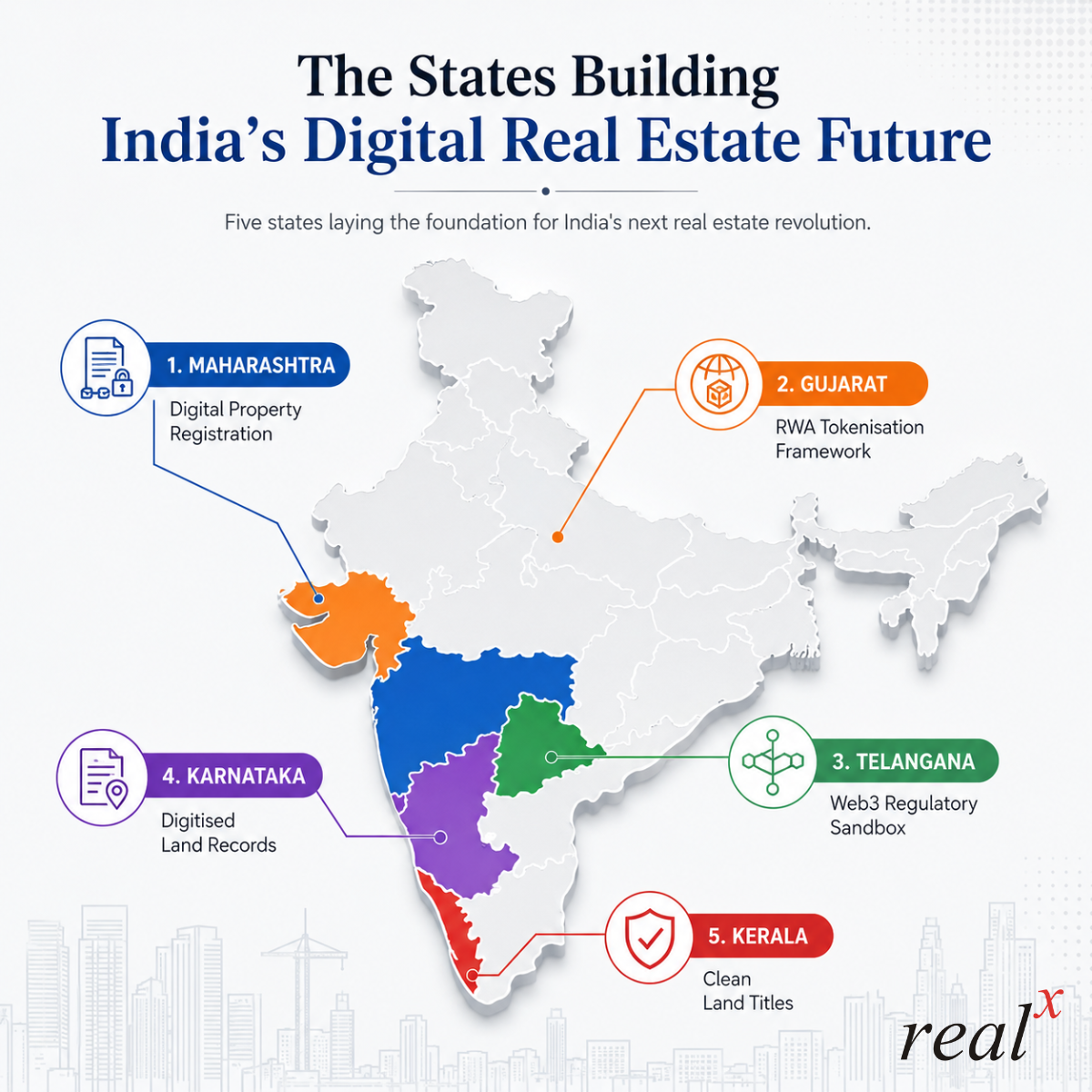
Across India, a handful of states are quietly building the digital infrastructure that could redefine how real estate is owned, verified and invested in. Maharashtra, Gujarat, Telangana, Karnataka and Kerala are no longer competing only on ease of doing business or infrastructure development. They are competing on how efficiently property can move through a digital ecosystem.
Collectively, these five states account for well over 60% of India’s commercial real estate investment, making them the country’s largest centres of institutional capital. What is changing is not the volume of investment, but the systems that support it. Digital land records, electronic registrations, blockchain pilots, regulatory sandboxes and cleaner title databases are gradually replacing fragmented, paper-driven processes that have existed for decades.
Maharashtra has emerged as one of the strongest examples of this transition. Through its digital registration framework, property transactions can now be executed using Aadhaar-based authentication without requiring every stakeholder to be physically present. The state’s blockchain initiatives further strengthen the integrity of these records by creating tamper-evident transaction histories. While these reforms were introduced to improve governance, they also create the foundation required for digital ownership models.
Gujarat has taken a different approach. Through GIFT City and the International Financial Services Centres Authority (IFSCA), it has become India’s gateway for regulated Real-World Asset (RWA) tokenisation. Rather than focusing only on digitising domestic processes, Gujarat is creating a framework through which global investors can participate in Indian assets under internationally recognised regulatory standards.
Telangana has concentrated on building technical standards. By working with industry bodies to establish Web3 regulatory sandboxes and asset tokenisation guidelines, the state is enabling companies to test blockchain-based ownership models within a supervised environment. Karnataka and Kerala, meanwhile, are addressing one of the oldest challenges in Indian real estate—title risk. Automated land mutations, digitised records and initiatives to establish a single source of ownership truth are steadily improving confidence in property data.
Viewed individually, these initiatives appear to be governance reforms. Viewed together, they reveal something much larger. They are building the digital rails on which the next generation of real estate transactions will operate.
The market data reinforces this shift.
Indian real estate attracted US$3.2 billion in private equity investment during the first half of 2026, representing a 33% year-on-year increase. Institutional capital continues to flow towards high-quality commercial assets, particularly in the same states that are investing heavily in digital infrastructure.
At the same time, the investment landscape itself is expanding. India’s fractional real estate market, currently valued at around US$500 million, is projected to reach nearly US$5 billion by 2030, reflecting growing demand for accessible investment products that lower entry barriers without compromising asset quality.
Regulatory developments are adding further momentum. Industry estimates suggest that SEBI’s Small and Medium REIT (SM REIT) framework could unlock nearly ₹71,000 crore worth of commercial real estate while creating a potential market exceeding US$60 billion, backed by more than 300 million square feet of Grade-A office space. These reforms are broadening institutional participation while creating pathways for previously illiquid assets to enter organised investment structures.
Perhaps the most significant transformation is happening at the investor level. Premium commercial real estate has traditionally required investments running into several crores, restricting participation to institutions and ultra-high-net-worth investors. New ownership models are gradually reducing that threshold to investments beginning at around ₹5 lakh, allowing a much larger pool of investors to participate in institutional-grade assets.
This is where the conversation naturally moves beyond digitisation.
Digitising land records does not, by itself, change the way real estate is owned. Electronic registrations do not automatically improve liquidity. Regulatory sandboxes do not create new investment opportunities on their own. They simply establish the infrastructure upon which new ownership models can be built.
Tokenisation is one such model.
Just as digital banking laid the foundation for UPI, and widespread internet adoption enabled India’s digital commerce revolution, digital property infrastructure creates the conditions necessary for fractional ownership, programmable compliance and transparent asset transfers. Tokenisation is therefore not the starting point of this transformation; it is the logical outcome of years of digital reform.
The states leading this transition understand that the future of real estate will not be determined solely by the buildings they construct, but by the efficiency with which those buildings can be financed, owned and transacted.
India’s next real estate boom is unlikely to be defined only by new skylines.
It will be defined by the digital infrastructure that allows capital to move through them more efficiently.

With a strong interest in markets and emerging financial infrastructure, I’m driven by how thoughtful design and disciplined decision-making can create lasting value. My work centres on creating robust financial frameworks that balance innovation with stability and long-term impact. I believe the best outcomes come from patience, clarity and long-term thinking.
Connect: radhika@realx.in