
What if stock markets are never closed?
What if settlement took seconds instead of days?
What if owning a piece of Tesla or Nvidia was as seamless as sending a digital transaction?
On 18th March 2026, Nasdaq took a decisive step toward that future. After receiving approval from the U.S. Securities and Exchange Commission, the exchange announced plans to introduce tokenized versions of publicly listed equities – marking a turning point in how traditional financial infrastructure evolves.
At its core, tokenised stocks are digital representations of traditional shares, recorded and transferred on blockchain networks. But their significance goes far beyond digitization. They challenge the very mechanics of markets – how ownership is tracked, how trades are settled, and how efficiently capital moves.
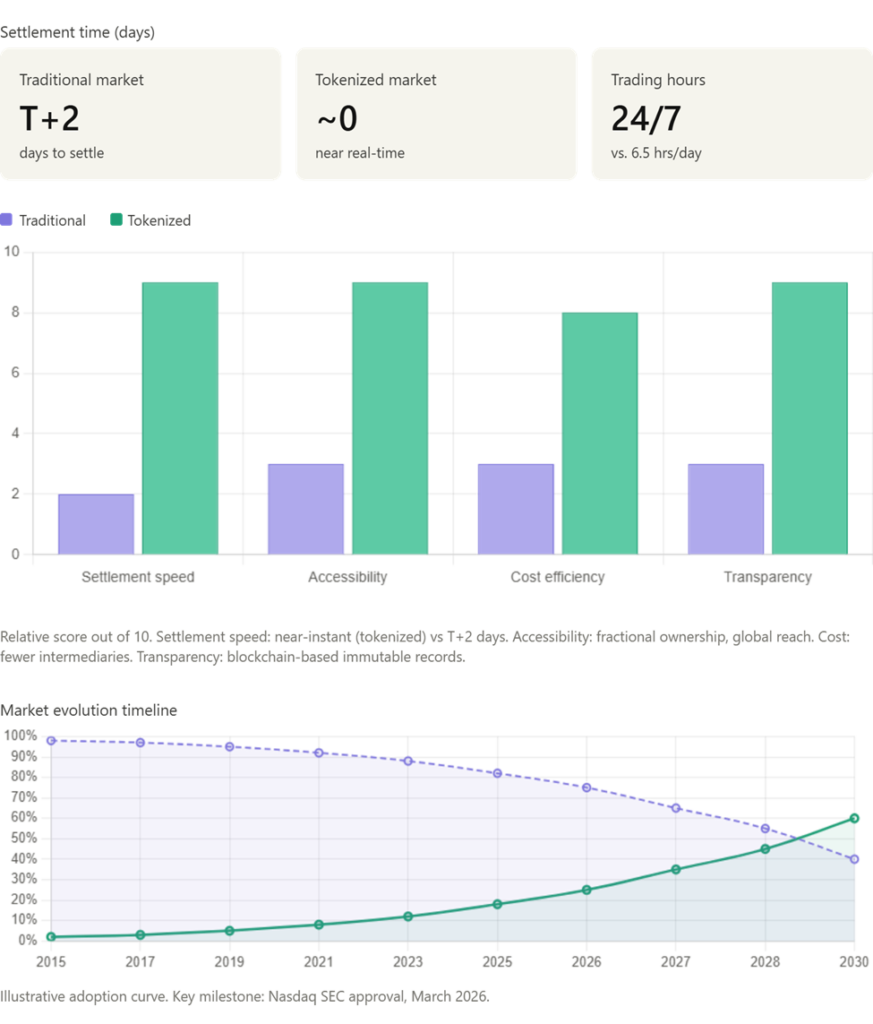
Today’s equity markets still rely on multi-layered systems built decades ago. Transactions pass through brokers, clearing houses, and custodians, often taking days to settle. Tokenisation compresses this stack. Ownership can update in near real-time, transparency improves and operational friction reduces. Intermediaries don’t disappear – but their roles evolve toward oversight, compliance and infrastructure.
This is where the shift becomes structural.
For years, blockchain innovation existed on the fringes – parallel ecosystems experimenting with new models. Nasdaq’s move signals something different. It embeds blockchain into the core of public markets, marking a transition from experimentation to integration. Traditional finance is no longer resisting change; it is actively absorbing it.
And with that, the market begins to open up in new ways.
Imagine continuous markets that extend beyond trading hours, fractional ownership unlocking participation at scale and global investors accessing assets without the usual structural barriers.
This is not just about efficiency – it is about expanding access.
However, access alone does not create markets. Liquidity still depends on demand, trust and distribution. Tokenisation enables the rails, but participation builds the ecosystem. Early tokenized markets will likely evolve through hybrid models – where institutional capital, curated platforms and compliant infrastructure come together to create depth.
This is where the second-order impact becomes important.
As assets become easier to digitise and distribute, the bottleneck shifts. The challenge is no longer just creating products, it is enabling discovery, building trust and aggregating demand. In other words, value begins to move from asset creation to access and distribution.
For emerging markets like India, this shift is particularly relevant. As global standards evolve, there will be increasing pressure to build compliant tokenisation frameworks, improve investor access, and modernise wealth infrastructure. The opportunity is not just to replicate global models, but to leapfrog into more efficient, digital-first systems.
And this is where platforms operating at the intersection of traditional finance and digital infrastructure stand to benefit.
As tokenisation gains popularity at the level of institutions like Nasdaq, it reduces friction across the ecosystem. Investor awareness increases. Regulatory conversations accelerate. Trust, begins to strengthen. All of this expands the addressable market for platforms enabling access to alternative and tokenised assets.
This evolution reinforces a core thesis: the future of investing will not be defined solely by what assets exist, but by how seamlessly investors can access them. As global markets move toward fractionalisation, transparency and digital ownership, the role of platforms that simplify discovery, ensure compliance and enable participation becomes significantly more valuable.
Because ultimately, this transition is not just about tokenising stocks, it is about reshaping how capital flows.
Access to better assets.
Access to global opportunities.
Access to a more efficient financial system.
Nasdaq’s move may appear as a single milestone, but it signals a broader transformation already underway. And as this transformation unfolds, the defining players will not just be those who create assets – but those who make them accessible.
References: https://www.reuters.com/legal/government/nasdaq-receives-sec-nod-trading-tokenized-securities-2026-03-18/ https://www.morningstar.com/news/marketwatch/20260221191/say-goodbye-to-the-4-pm-closing-bell-your-stocks-are-becoming-247-digital-cash

With a strong interest in markets and emerging financial infrastructure, I’m driven by how thoughtful design and disciplined decision-making can create lasting value. My work centres on creating robust financial frameworks that balance innovation with stability and long-term impact. I believe the best outcomes come from patience, clarity and long-term thinking.
Connect: radhika@realx.in