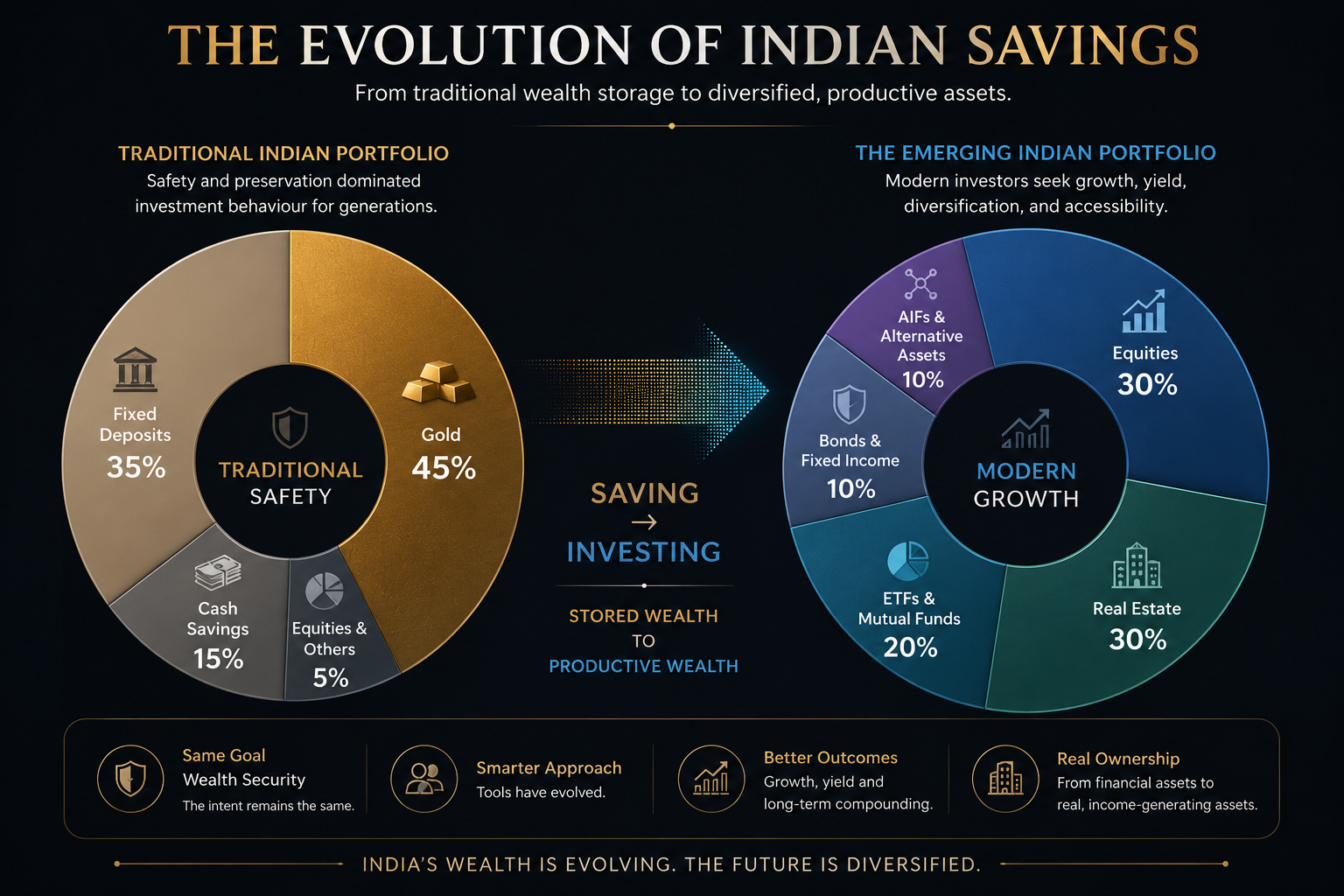
The Investment Evolution: From Pure Gold to Real Assets
The global economy is undergoing a structural transformation.
Rising inflation, geopolitical uncertainty, changing monetary policies and evolving investor behaviour are reshaping how the world stores and grows wealth. Developing economies like India are experiencing this shift more intensely than ever before.
And perhaps nowhere is this transformation more visible than in the changing mindset around savings and investments.
A recent statement by India’s Prime Minister highlighted a growing national focus toward financial assets and productive investments – signalling a deeper evolution in how Indians may preserve and build wealth in the coming decades.
For generations, India’s safest financial refuge was simple:
GOLD.
Not just as an investment. But as tradition. As emotion. As security.
Across decades, Indian households accumulated gold in every possible form:
jewellery,
coins,
bars,
savings schemes,
SIP-like jewellery plans,
Inherited family wealth.
Gold represented certainty in uncertain times.
But today, that long-standing equation is beginning to change.
The Shift Has Already Begun
Gold may never completely lose its importance in India.
But the nature of gold ownership is changing rapidly.
High prices, changing regulations, rising import costs, taxation structures and the emergence of modern financial products are gradually reducing the dominance of traditional physical gold investments.
This does not mean Indians will stop saving.
In fact, during times of uncertainty, people often save more.
The real question is:
If not gold, then where does the capital go ?
The Rise of Alternative Wealth Assets
Indian investors are increasingly looking toward assets that can offer:
long-term appreciation,
inflation protection,
income generation,
relatively balanced risk.
This capital is gradually moving toward:
Equities,
Real Estate,
Bonds,
REITs,
ETFs,
Alternative Investment Funds (AIFs).
Equities:
Equity investing has become mainstream in India.
The rise of:
digital brokerages,
financial education,
SIP culture,
easy market access
has transformed stock market participation from a niche activity into a mass investment movement.
Younger investors no longer want idle capital.
They want ownership in businesses, industries and India’s economic growth story.
But despite the rise of equities, another asset class continues to hold deep emotional and financial significance in India:
Real Estate: India’s Next Wealth Magnet
Real estate has always been one of India’s most aspirational investments.
For decades, owning land or property symbolized:
security,
status,
generational wealth.
Now, as investors look beyond gold, real estate is once again emerging as a preferred destination for long-term capital.
And the reason is simple.
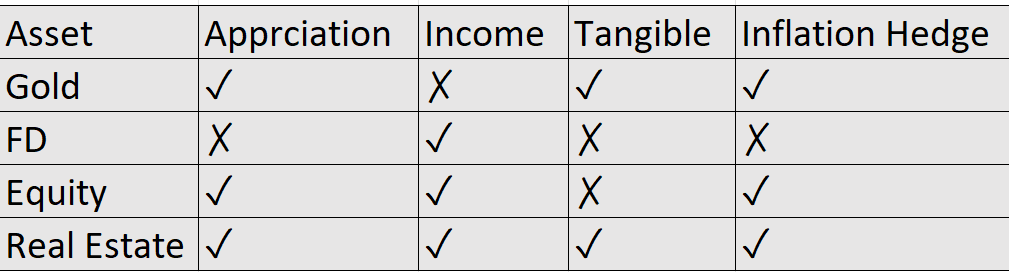
Unlike gold, real estate offers:
price appreciation,
tangible ownership,
income generation.
Land appreciates over time.
Premium properties appreciate and generate rental yields.
This dual-return structure makes real estate increasingly attractive in an uncertain economic environment.
At the same time, urbanization, infrastructure growth and increasing demand for premium assets continue to strengthen long-term real estate demand.
But there is one major challenge.
The Accessibility Problem
Buying premium real estate is expensive.
Acquiring:
acres of land,
commercial spaces,
institutional-grade properties
requires substantial capital.
And in a country like India, where millions of households invest through small monthly savings, traditional real estate ownership remains inaccessible for a large section of investors.
People may want exposure to premium real estate.
But not everyone can buy an entire property.
This is where the investment landscape is evolving again.
The Rise of Fractional Real Estate
Modern financial innovation is changing how real estate ownership works.
Today, investors no longer need to purchase an entire building or property to participate in the real estate market.
Fractional ownership models are making it possible to invest in real estate through smaller, more accessible units.
Platforms like RealX are enabling investors to participate in institutional-grade real estate opportunities through fractional investment structures such as FRAX.
Instead of requiring crores to enter premium real estate markets, investors can now own smaller portions almost like buying a “square inch” of real estate.
This changes the entire equation.
Now:
savings can become real estate exposure,
smaller investors can access premium assets,
and wealth creation through property is no longer limited only to ultra-high-net-worth individuals.
It introduces a new possibility for Indian investors:
Converting monthly savings into ownership of yield-generating real-world assets.
The Future of Indian Investing
India is not abandoning traditional wealth principles.
It is evolving them.
The next generation of investors still wants:
safety,
stability,
tangible assets.
But they also want:
liquidity,
accessibility,
transparency,
better risk-adjusted returns.
This is why the future of investing is becoming increasingly diversified.
Gold may remain culturally important.
But capital is beginning to flow toward assets that can do more:
generate income,
compound wealth,
participate in economic growth.
And as this transition accelerates, India may witness one of the biggest shifts in investment behaviour in its modern financial history – moving from passive wealth storage toward productive, technology-enabled asset ownership.
With a strong interest in markets and emerging financial infrastructure, I’m driven by how thoughtful design and disciplined decision-making can create lasting value. My work centres on creating robust financial frameworks that balance innovation with stability and long-term impact. I believe the best outcomes come from patience, clarity and long-term thinking. Connect: radhika@realx.in