
Why Real Estate Markets Keep Growing?
A person buys a premium property in an upcoming location. At the time, most people around them think the price is too high. Some feel the area is still underdeveloped. Others believe there are better opportunities elsewhere.
But a couple of years later, the same property is worth significantly more.
Now the conversation changes.
Friends start asking how they discovered the location so early. Colleagues begin researching projects in the same area. Investors who once ignored the market suddenly want exposure to it.
And this is usually how a real estate cycle begins accelerating.
Not just through infrastructure or economic growth – but through visibility, social proof and participation.
Real estate is one of the few asset classes people can physically experience. You can see new roads being built, office towers rising, malls opening and residential projects expanding. When a location begins changing rapidly, people don’t just observe development – they begin associating that area with future wealth.
That perception matters more than most people realise.
Because investment decisions are rarely made in isolation. People constantly look for signals from those around them. If someone close to them generates strong returns from a property investment, the opportunity suddenly feels more real and more achievable.
The market gains credibility.
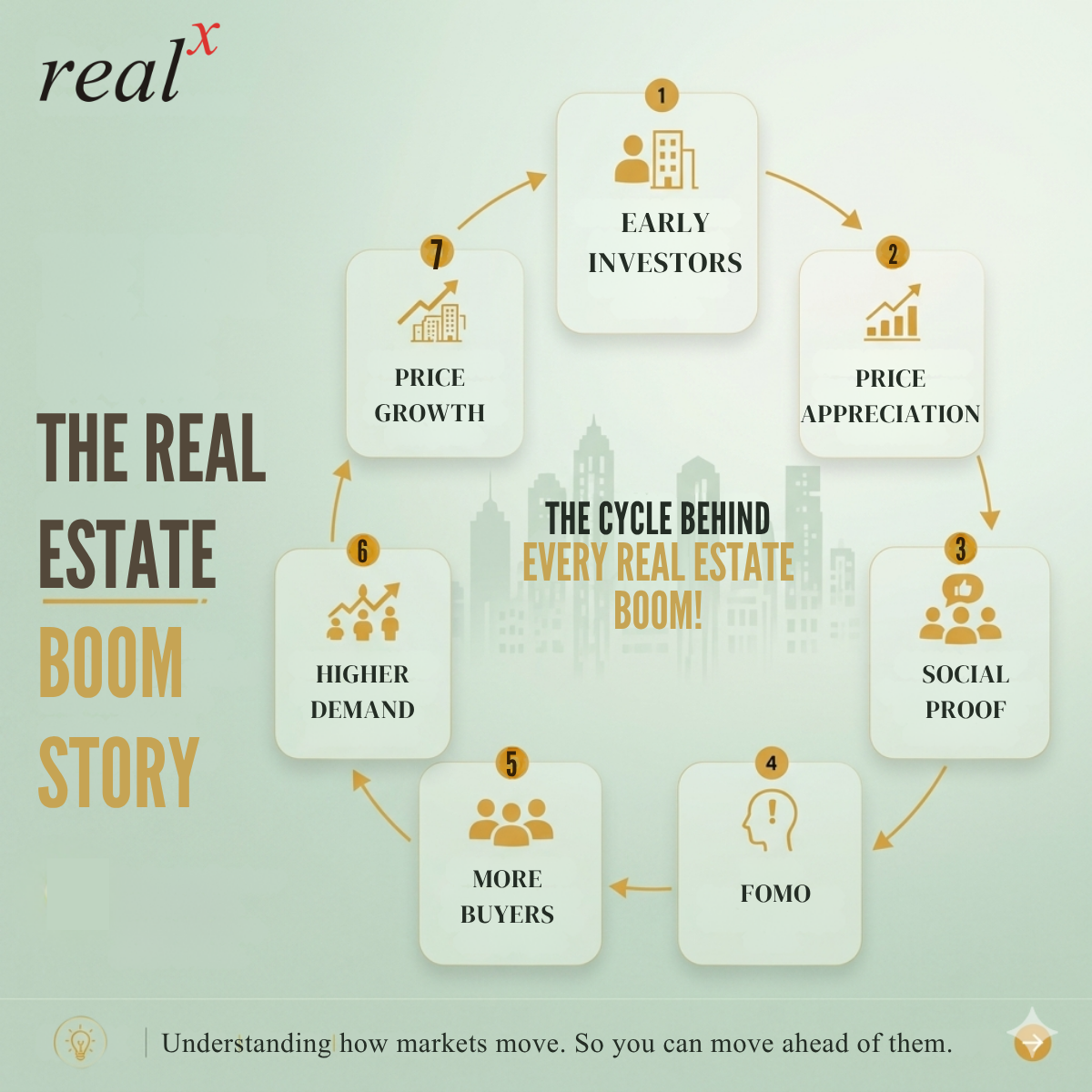
Most major real estate markets start quietly.
In the early stages, only a small group of investors enters. Usually, they are responding to structural signals:
- Improving connectivity,
- Upcoming infrastructure,
- New employment hubs,
- Affordability compared to already expensive areas.
At this point, the broader market is still uncertain. Prices may feel risky and Demand is still limited.
But as development progresses, prices begin moving upward. Rental demand increases and many more projects are launched.
The area slowly enters public conversation and this is exactly where momentum starts building.
Once people begin seeing visible appreciation, a psychological shift happens.
The market is no longer viewed as an uncertain opportunity but has become a proven one.
And that creates a powerful reaction:
Fear of missing out.
Not in the superficial social media sense – but in the financial sense.
People begin thinking:
“If this area keeps growing, entering later could become far more expensive.”
As more buyers enter the market, demand rises rapidly. But unlike many other assets, real estate supply cannot expand instantly. Because Land is limited and on top of it, approvals and construction take years.
So when demand increases faster than supply, prices rise aggressively.
This is one of the reasons premium micro-markets often compound so quickly.
Take Bengaluru’s Whitefield as an example.
Years ago, many considered it too far from the city center. But as the IT ecosystem expanded and connectivity improved, professionals started moving into the area.
The early investors benefited from appreciation first.
Then came the second wave – people who saw those investors making money.
More buyers entered. Developers expanded aggressively. Infrastructure improved further. Over time, Whitefield transformed into one of the city’s strongest real estate corridors.
The growth was driven not just by infrastructure, but by the concentration of belief and capital.
A similar pattern played out in Gurgaon.
Luxury projects, multinational offices and high-income professionals created an ecosystem that attracted more wealth into the market. Once the city developed a reputation as a premium investment destination, demand accelerated further.
People were no longer buying only for utility.
They were buying because they believed the market represented future wealth creation.
That belief itself became a growth driver.
This is what makes real estate different from many other asset classes.
Markets do not grow only because buildings are constructed or infrastructure improves. They grow because enough people collectively believe a location will become more valuable in the future.
And once that belief spreads, capital follows.
A few early investors create momentum.
That momentum attracts more participation.
More participation increases demand.
And in a supply-constrained market, concentrated demand pushes prices upward.
Over time, an ordinary location becomes a premium one.
Not only because the city developed around it –
but because people decided it was where the future would be.

With a strong interest in markets and emerging financial infrastructure, I’m driven by how thoughtful design and disciplined decision-making can create lasting value. My work centres on creating robust financial frameworks that balance innovation with stability and long-term impact. I believe the best outcomes come from patience, clarity and long-term thinking.
Connect: radhika@realx.in