
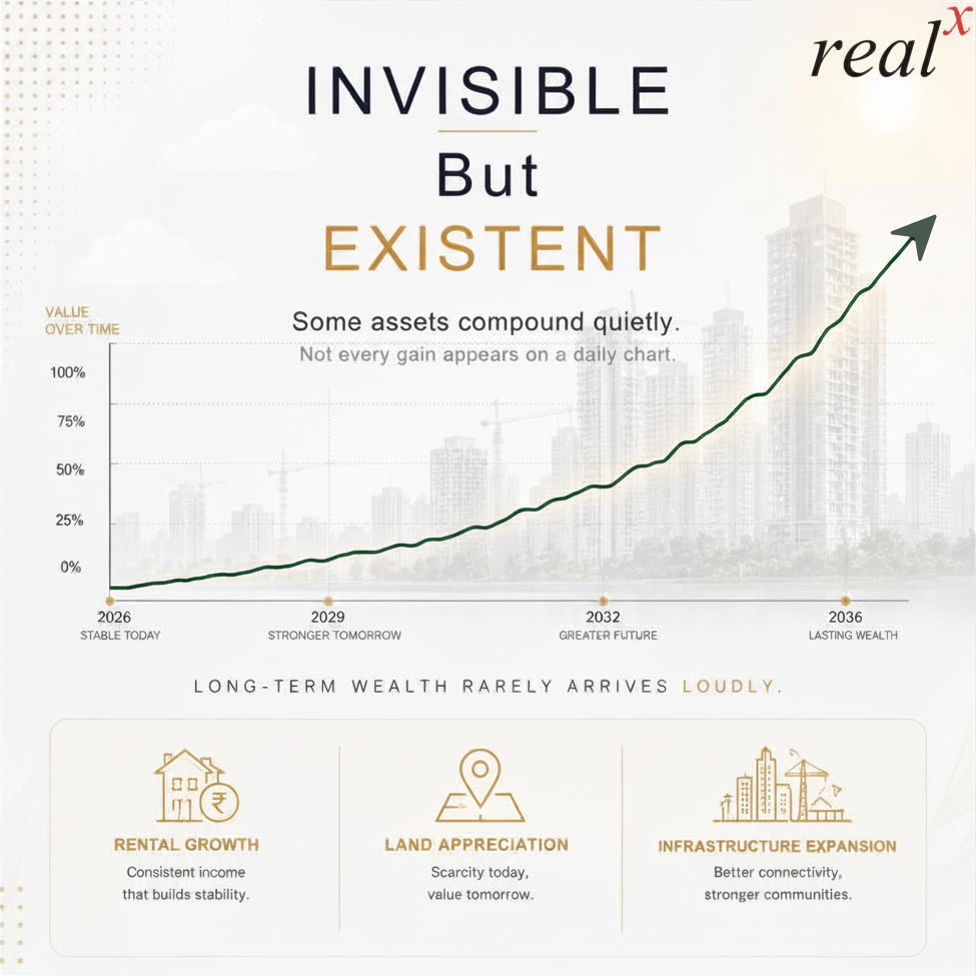
One of the most common misconceptions in investing is that performance must be visible to be real.
We live in a world of constant information. Stock prices update every second, cryptocurrencies trade 24/7, and market news reaches us instantly. Over time, many investors begin to associate activity with progress.
The more frequently we see an asset move, the more convinced we become that something meaningful is happening.
But what if this is simply an information bias?
What if some of the most powerful forms of wealth creation happen precisely where nobody is looking?
This is where real estate stands apart.
Unlike most financial assets, real estate does not provide continuous price discovery. There is no daily chart showing the value of a property. No live ticker displaying minute-by-minute appreciation. As a result, many people assume that little is happening.
The reality is often the opposite.
While investors focus on visible price movements elsewhere, real estate frequently compounds through forces operating quietly beneath the surface.
Rental income gradually increases as demand grows and leases renew at higher rates. Land appreciates as populations expand, businesses move in, and economic activity concentrates around key locations. Infrastructure projects improve connectivity, unlock demand and enhance the attractiveness of entire regions.
None of these drivers create dramatic daily headlines.
Yet together, they can create substantial long-term wealth.
This creates an interesting psychological effect – Information Bias.
Investors often underestimate real estate performance not because the asset is underperforming, but because the performance is difficult to observe in real time.
In behavioral finance, people naturally give greater importance to information that is readily available. Daily stock prices, market indices, and market commentary become highly visible reference points. Slow-moving appreciation, by contrast, receives far less attention.
The result is a bias toward visibility.
What can be seen is perceived as important. What cannot be seen is often ignored.
This helps explain a phenomenon that repeatedly occurs across property markets.
An investor revisits a location after several years and suddenly concludes that prices have become expensive. The assumption is that values rose sharply over a short period.
But in many cases, the appreciation was neither sudden nor unexpected.
It was simply unnoticed.
The growth accumulated gradually through years of rental demand, infrastructure development, urban expansion, and increasing scarcity. By the time the market recognizes the outcome, much of the compounding has already occurred.
What appears to be a sudden jump in value is often the visible result of a process that has been unfolding quietly for years.
This observation extends beyond real estate.
Some assets generate attention because their prices fluctuate constantly. Others generate wealth because their fundamentals improve consistently.
The two are not always the same.
The lesson is not that every real estate investment will outperform other asset classes.
The lesson is simpler:
Visibility and performance are not synonyms.
An asset does not need to update every second to create wealth. In fact, some of the most durable forms of compounding occur when nobody is watching the chart.
Long-term wealth rarely arrives with breaking news alerts.
More often, it emerges quietly, gradually, and almost – til one day everyone notices.
And by then, much of the compounding has already happened.

With a strong interest in markets and emerging financial infrastructure, I’m driven by how thoughtful design and disciplined decision-making can create lasting value. My work centres on creating robust financial frameworks that balance innovation with stability and long-term impact. I believe the best outcomes come from patience, clarity and long-term thinking.
Connect: radhika@realx.in