
For the last few years, India’s residential real estate cycle has been dominated by premiumisation.
Developers across major cities aggressively shifted toward larger homes – 3BHKs, 4BHKs, luxury towers, gated communities and branded residences. The logic was straightforward: higher margins, faster balance-sheet recovery after the pandemic and strong demand from affluent buyers seeking larger living spaces.
For a while, the strategy worked exceptionally well.
Premium housing became the engine of India’s property market recovery.
But cycles evolve.
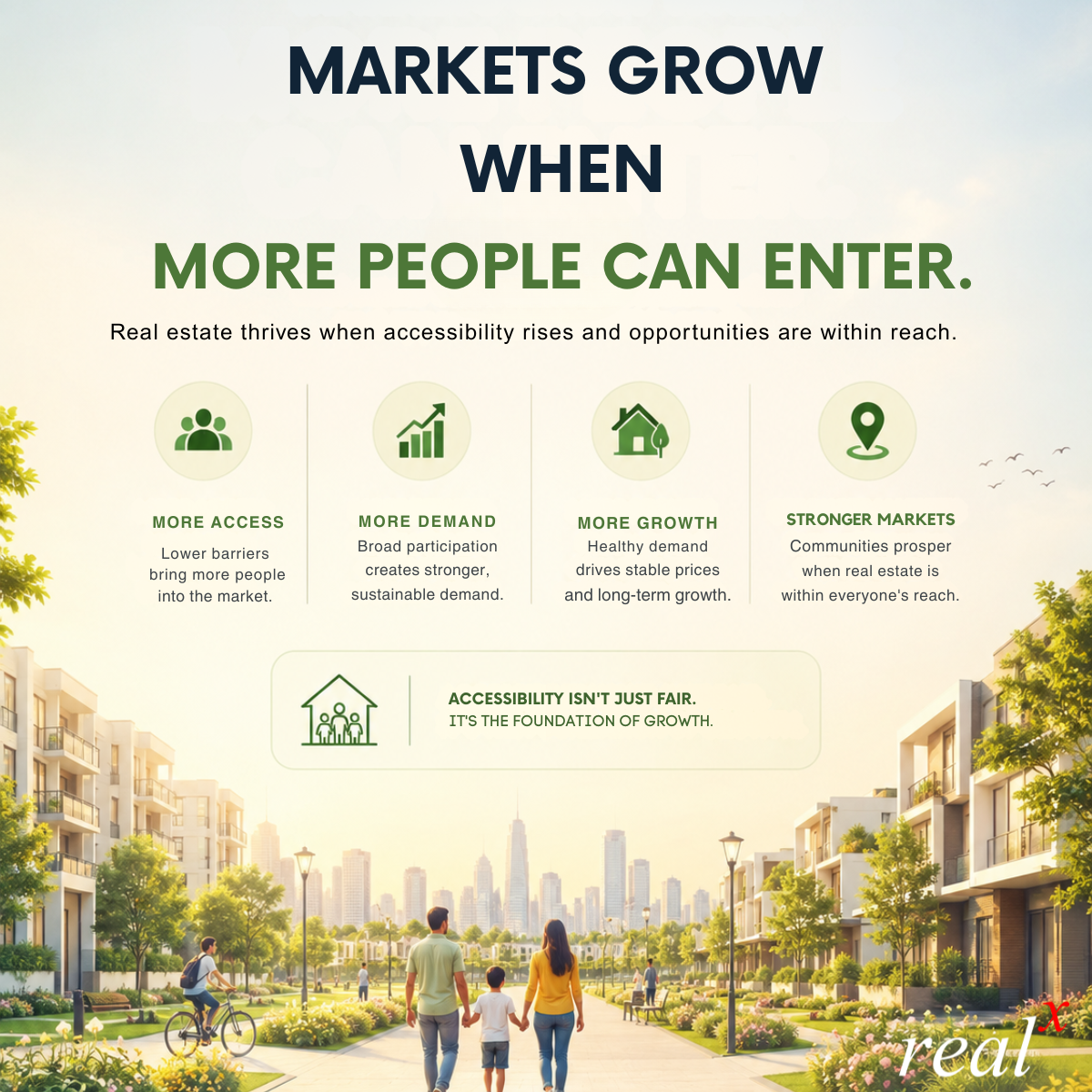
And today, early signals suggest that India’s next real estate growth phase may not be driven by luxury housing alone – it may increasingly pivot back toward affordability, accessibility and broader participation.
This is not merely a housing trend.
It is a deeper story about market scalability, capital allocation and the economics of participation.
The Premium Housing Boom
Post-pandemic India witnessed one of the strongest premium housing cycles in recent history.
Remote work, rising household aspirations, wealth creation through equities and startups and low interest rates during the recovery phase pushed affluent buyers toward larger homes.
According to a recent Knight Frank India report, homes priced above ₹1 crore accounted for nearly 50% of all residential sales in 2025. Sales in the premium segment rose 14% year-on-year, while affordable housing sales declined sharply.
The divergence became even more visible in supply trends:
- New launches in the sub-₹50 lakh category declined by 28% YoY.
- Mid-income launches also softened.
- Developers increasingly concentrated capital toward premium inventory where margins were significantly higher.
For developers, the economics were compelling.
Land prices in major cities surged.
Construction costs increased materially.
Regulatory and financing costs remained elevated.
In such an environment, luxury projects offered better return-on-capital efficiency than affordable housing.
The market structurally tilted upward.
Why Premium Cycles Eventually Slow
However, every premium-led cycle faces a natural limitation:
The buyer pool becomes progressively smaller.
As ticket sizes rise, market participation narrows.
A ₹3 crore apartment automatically excludes the vast majority of urban households. Even upper-middle-class buyers become sensitive to EMI burdens when interest rates remain elevated and income growth moderates.
This is already beginning to reflect in market behaviour.
Housing sales across India’s top eight cities declined in early 2026, with demand moderation visible in several key urban markets.
Even in premium-heavy markets like Hyderabad, reports suggest cooling transaction volumes and slower luxury absorption.
The issue is not that premium demand disappears entirely.
India will continue producing wealthy buyers, entrepreneurs, NRIs, startup employees and high-income professionals.
But premium housing alone cannot sustain long-duration, broad-based growth for the entire sector.
Because scalability in any market ultimately depends on participation breadth.
The Middle-Class Buyer Is Becoming Structurally Important Again
This is where the affordable and mid-income segments regain importance.
For years, India’s middle-class homebuyer was gradually pushed out of urban property markets due to:
- Rapid price appreciation
- Higher EMIs
- Elevated input costs
- Shrinking affordable supply
- Developers prioritising luxury inventory
But markets eventually respond to participation constraints.
When affordability deteriorates too sharply, transaction velocity slows.
And transaction velocity is critical in real estate.
Unlike luxury inventory, accessible housing creates:
- Larger buyer pools
- Faster inventory turnover
- Broader financing participation
- Higher market depth
- More stable long-term absorption
In simple terms:
A market with one million potential buyers scales more sustainably than a market with fifty thousand affluent buyers.
This is why affordability eventually becomes economically necessary – not socially desirable alone.
Real Estate Is Following the Same Logic as Financial Markets
The underlying principle is not unique to housing.
Every scalable asset class grows fastest when participation expands.
Equity markets deepened when retail investing became accessible.
Mutual funds scaled when SIPs lowered entry barriers.
Digital payments exploded when transaction friction declined.
Real estate operates under the same structural logic.
Lower ticket sizes increase:
- ownership accessibility,
- capital circulation,
- liquidity potential,
- market depth.
This is particularly important in a country like India, where demographic expansion and urbanisation continue to create enormous latent housing demand.
The long-term growth opportunity lies not only in luxury towers – but in enabling wider participation across the urban middle class.
The Economics of Smaller-Ticket Housing
Affordable housing has historically faced one major challenge:
Margins.
Developers often prefer premium projects because:
- land costs are fixed,
- approval timelines are long,
- financing remains expensive,
- premium pricing improves profitability.
However, a purely premium-focused market eventually creates concentration risk.
Capital becomes dependent on a narrow income cohort.
That makes demand more cyclical and less resilient.
Smaller-ticket housing changes the equation.
It broadens the absorption base.
And broad absorption is what sustains long-duration real estate cycles.
This is particularly relevant as:
- wage growth moderates,
- startup liquidity slows,
- equity wealth effects stabilise,
- urban affordability pressures intensify.
Several analysts and market observers are already discussing whether India’s residential market is entering a consolidation phase after an extended premium-led expansion.
Policy Could Accelerate the Shift
Government policy may also play an important role in reviving accessible housing demand.
Initiatives like Pradhan Mantri Awas Yojana continue to focus on affordable housing creation, although financing access and execution challenges remain visible in many regions.
If policymakers introduce:
- interest subsidies,
- tax incentives,
- faster approvals,
- infrastructure expansion,
- financing support for affordable projects,
the middle-income housing segment could regain significant momentum over the next cycle.
Because the underlying demand has never disappeared.
It was simply priced out.
The Next Real Estate Cycle May Look Different
India’s premium housing boom is unlikely to vanish overnight.
Luxury demand will remain an important component of urban real estate, especially in cities like Mumbai, Bengaluru, Hyderabad and Pune.
But the next major phase of scalable growth may increasingly come from:
- compact housing,
- mid-income inventory,
- peripheral urban development,
- accessible price points.
Because accessibility does not merely expand ownership.
It expands the market itself.
And in the long run, markets that maximise participation tend to become the largest, deepest and most sustainable.
India’s next housing cycle may therefore not be defined by the biggest homes.
It may be defined by the homes that the largest number of people can realistically afford.

With a strong interest in markets and emerging financial infrastructure, I’m driven by how thoughtful design and disciplined decision-making can create lasting value. My work centres on creating robust financial frameworks that balance innovation with stability and long-term impact. I believe the best outcomes come from patience, clarity and long-term thinking.
Connect: radhika@realx.in