

For decades, the foundation of portfolio construction rested on a rigid, three-dimensional framework: Risk, Return, and Time Horizon. Within this classic triad, liquidity was relegated to a passive, binary metric. An asset was either fundamentally liquid (like a blue-chip stock) or stubbornly illiquid (like a commercial office building). Investors accepted illiquidity as a static tax—an uncomfortable but necessary sacrifice required to capture institutional “alpha” (outperforming the market).
Today, that paradigm is collapsing. In an investment landscape defined by hyper-speed market shifts and a massive explosion of diverse investment choices, structural flexibility has transformed from a passive feature into an active source of returns. Increasingly, institutional allocators, family offices, and retail investors are paying a premium not just for the underlying value of an asset, but for the strategic freedom to exit, enter, and redeploy capital at a moment’s notice.
Liquidity is no longer just a characteristic of an asset. It is becoming an asset class of its own.
1. The Paradox of Abundance: Why Optionality is the New Alpha
The modern investor is faced with a paradox: there are more high-yield opportunities than ever before, yet capital is increasingly trapped in vehicles that prevent investors from seizing them. The investment universe has metastasized far beyond public equities and bonds, creating a dense ecosystem of alternative choices:
- Private Markets & Buyouts: Driven by corporate restructurings, AI infrastructure, and energy transitions.
- Early-Stage Venture & Startups: Capturing generational shifts in technology and software.
- Fractional Real Estate: Splitting massive commercial or residential buildings into accessible micro-shares.
- Digital Assets & Real-World Asset (RWA) Tokens: Bringing programmatic trading to historically static holdings.
However, as opportunities have expanded, liquidity has dried up in traditional alternative structures. According to data from McKinsey’s 2026 Global Private Markets Report, the backlog of private equity portfolio companies held for four years or longer has hit a staggering 52% of total buyout inventory—the highest level on record. Investors who historically anticipated a 4-to-5-year turnaround are finding their capital locked up for an average of 6.6 years before seeing a distribution.
When capital is locked away, the “opportunity cost” skyrockets. In a volatile macro environment, the ultimate luxury is not simply holding a high-yielding asset, but possessing optionality—the mathematical value of being able to choose what to do next. Because optionality is entirely dependent on liquidity, the market is beginning to systematically reprice assets based on how fast they can be converted back into a liquid state.
2. Quantifying Strategic Freedom
Liquidity delivers a form of defensive and offensive utility that standard return metrics fail to capture. When an investor commands structural liquidity, they gain four core competitive advantages:
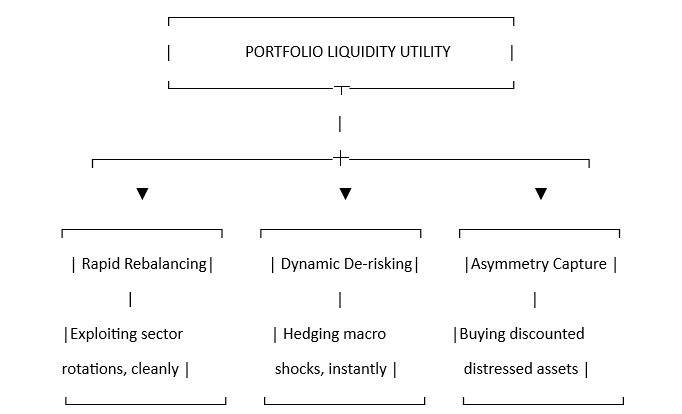
Consider the absolute performance spread in recent market cycles. During major market pivots, investors tied to traditional, slow-moving private allocations often suffer from the “denominator effect”—where their public stocks drop in value, leaving their illiquid, unpriced assets dangerously over-allocated on paper. Conversely, liquid-rich investors can deploy capital into sudden market dislocations, acquiring premium assets at a steep discount. In a world where macro conditions fluctuate quarter-to-quarter, the ability to act is worth more than a static, illiquid yield premium.
3. The Rise of Liquidity-Focused Infrastructure
The financial sector’s fastest-growing innovations over the last two decades have succeeded not because they invented new financial concepts, but because they engineered liquidity into places where it didn’t previously exist.
| Financial Innovation | Historical Illiquid State | Modern Liquid Evolution | Market Impact / Projection |
| ETFs | Mutual funds settled at end-of-day; high entry minimums. | Continuous, intraday exchange trading with instant execution. | Dominates global equity volumes; rapidly expanding into alternatives. |
| Fractional Platforms | Multi-million dollar minimums for fine art, commercial real estate, or private credit. | Micro-ownership shares divisible down to double-digit dollar amounts. | Retail segment driving global alternative inflows at a 47% to 50% CAGR. |
| Tokenization & RWAs | Months of legal paperwork, high brokerage fees, and heavy escrow delays. | On-chain digital representations traded on secondary permissionless or compliant venues. | Projected to scale from a $3.01 Trillion base to $18.74 Trillion by 2031. |
This infrastructure shift proves that the ultimate goal of modern financial engineering is the democratization of liquidity. Take the real estate market as an example. Historically, selling a commercial building required a 6-to-12-month marketing and closing cycle. Today, through blockchain-backed asset tokenization, property ownership can be divided into digital security tokens.
Market forecasts indicate that real estate tokenization will experience a blistering 21% Compound Annual Growth Rate (CAGR) through 2035, as institutional and high-net-worth investors migrate toward platforms that offer automated, on-chain secondary market matching at a fraction of traditional administrative costs.
4. The Future of Ownership: Liquidity Embedded by Design
As we look toward the next decade of capital allocation, the defining question for issuers, asset managers and founders will mutate.
The Old Paradigm: “What highly valuable asset can we create to attract investor capital?”
The New Paradigm: “How can we build continuous, frictionless liquidity directly into the architecture of our asset to command a market premium?”
We are moving rapidly toward a financial ecosystem where ownership and structural flexibility are inseparable. If a private equity fund, a real estate venture, or a venture debt facility cannot provide its Limited Partners (LPs) with functional, programmatic secondary market liquidity, it will be forced to offer a severe “illiquidity discount” to attract capital.
The next great wave of wealth creation will not be driven by discovering a brand-new, exotic asset class. Instead, it will be unlocked by building digital pipelines under our existing, multi-trillion-dollar illiquid asset classes—turning real estate, private credit, and venture equity into highly liquid, continuously traded instruments.
Closing Thought
The financial landscape is shifting from a game of accumulation to a game of velocity. In an era of abundant, fast-moving global opportunities, the ultimate measure of financial strength is no longer just the total volume of your balance sheet. It is the answer to a single, operational question:
How quickly can you redeploy your capital when the world changes?

With a strong interest in markets and emerging financial infrastructure, I’m driven by how thoughtful design and disciplined decision-making can create lasting value. My work centres on creating robust financial frameworks that balance innovation with stability and long-term impact. I believe the best outcomes come from patience, clarity and long-term thinking.
Connect: radhika@realx.in